
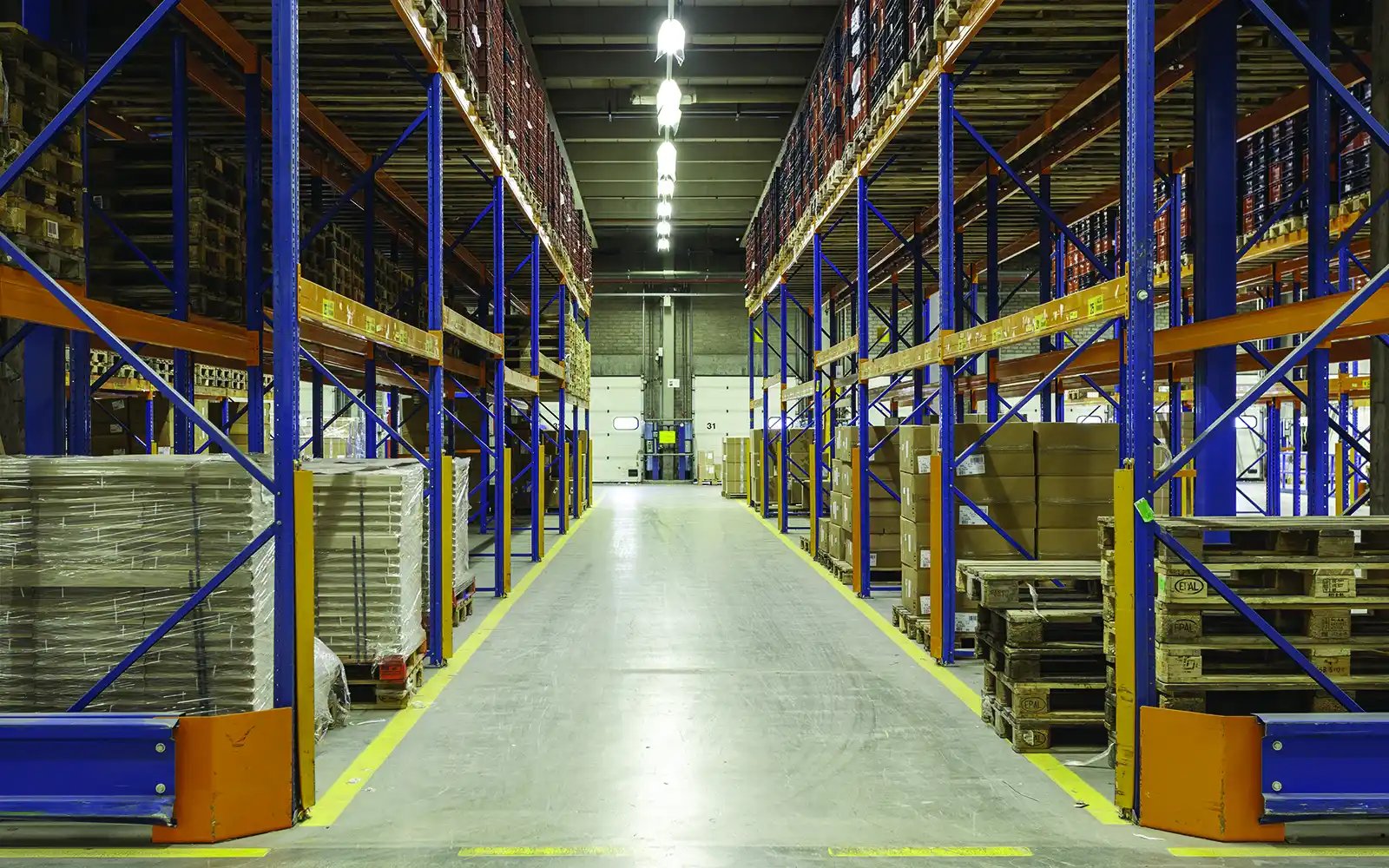
Warehouse Builders of New Mexico works where the truck, the train and the border meet. The state's freight moves on three lines: the port of entry at Santa Teresa in the south, Interstate 25 running north from there through Las Cruces and Albuquerque, and Interstate 40 carrying east-west freight alongside the BNSF Southern Transcon. We build the distribution centers, cross-docks, rail-served shells and fulfillment buildings that sit on those lines.
A warehouse here is judged by how fast freight gets in and out. Clear height, dock count, truck court geometry, slab flatness and rail access decide that. Everything else is secondary, so that is where we spend our attention.
Warehouse construction services across New Mexico. View services
Santa Teresa is where we think about cross-border freight first. The community is home to the Santa Teresa Port of Entry and the 1,100 acre Santa Teresa Gateway Rail Park, which is served by the Santa Teresa Southern Railroad and interchanges with a Class I carrier. A tenant here may move product by truck in one direction and by rail in the other, and the building has to handle both.
We build for that mix. In Santa Teresa, that means tilt-wall shells with enough dock doors to match throughput, truck courts that survive heavy trailer turning, utilities sized for the tenant and a slab that holds up under racking and forklifts. Private builders have put up speculative warehouse space in the area, and a tenant who needs a different layout often asks for a build-to-suit. We build both kinds of building and we can talk you through which one fits.
Sunland Park, Anthony and Las Cruces sit within a short drive of the same corridor. Las Cruces is the southern end of I-25 and meets I-10 there, and its Innovation and Industrial Park sits at that junction beside the city's international airport. For a distributor that needs to reach the port of entry, cross-border carriers and the interstate network in the same day, that stretch of the Rio Grande valley is hard to beat.
Interstate 25 and Interstate 40 cross in central Albuquerque at the interchange known as the Big-I. That crossing makes the metro the natural hub for regional distribution, and the figures back it up. The Albuquerque International Sunport reported more than 83 million pounds of cargo in 2025. Local industrial vacancy has stayed low by historical standards, and a recent broker report noted rising rents and a lack of new supply. Tenants who need space find that supply thin.
We build warehouse and distribution space in Albuquerque and across the metro, including the South Mesa near Mesa del Sol and the west side toward Rio Rancho. The work covers speculative shells for developers, build-to-suit buildings for operators and expansions for companies that have outgrown a first building. Site constraints matter here. The valley runs from about 4,900 feet by the river to more than 6,700 feet in the foothills, so grade, drainage and wind exposure change from one parcel to the next.
South of the metro, Belen deserves its own mention. Interstate 25 forms the city's western edge, the BNSF rail yard there is a division point on the Southern Transcon and the Rio Grande Industrial Park offers about 365 acres of marketed industrial ground. Rail, highway and open land in one place is the combination that rail-served warehouse tenants look for. Los Lunas, just north, adds more room along the same corridor.
Along I-40, freight crosses the state without stopping unless there is a reason to stop. Our job is to give it one. Gallup sits on I-40 and the BNSF mainline, with US 491 running north from the interchange. Moriarty has a business park beside I-40 east of the mountains. Farther east, Clovis is a BNSF division point where more than 100 mostly intermodal trains come and go each day, and its industrial park offers rail and utility service on shovel-ready ground.
These are smaller markets than Albuquerque, and the buildings are often smaller too. A regional distributor, a building products supplier or a food processor may want one tilt-wall box or a metal-framed shell with a few dock positions. We scale the building to the tenant, keep the dock and truck court design honest and avoid paying for height or door counts you will not use.
Our core work is the tilt-wall warehouse: site-cast concrete panels, steel roof framing, a thick slab and a clear height set by the racking plan. For handling-heavy freight we design cross-dock facilities with doors on both faces, long narrow footprints and truck courts that keep trailers moving. Those buildings link directly to the truck terminal and cross-dock buildings that carriers operate.
We also build distribution centers, cold storage, fulfillment and e-commerce buildings, 3PL facilities, last-mile parcel hubs, food-grade warehouses and rack-supported structures. Add-on scopes include mezzanine offices, dock levelers and equipment, ESFR fire protection coordination, site utilities and trailer yard paving. Where the project needs it, we handle expansions that tie new bays into an operating building without shutting down the docks.
The slab deserves its own paragraph. It is the largest single cost in the shell and the part that is hardest to fix later. We specify and place super flat floor slabs where very narrow aisle or high-reach equipment requires them, and we plan joints, curing and saw cutting around the heat and wind that large pours in this state face. A big slab in New Mexico dries fast. We watch temperature, wind and humidity on pour day and adjust the mix, the placement sequence and the cure to match.
Our customers are developers, owners and operators who move goods. Logistics and 3PL operators are the largest group, followed by ecommerce fulfillment companies, cold-chain food distributors, retail and building products distributors, auto parts distributors and manufacturers that need a distribution wing. We also work with developers and REITs that build speculative space on a schedule set by lease-up, not by a single tenant.
Each of those customers cares about a different number. A 3PL cares about door count and flexibility. A cold-chain operator cares about insulation, vapor barriers and floor slab protection. A developer cares about cost per square foot and how fast a shell can be turned over. We ask for that number in the first conversation.
We start with the freight: truck counts, trailer types, rack heights, rail needs. From there we look at the site, which means soils, utilities, drainage, the approach from the interchange and what the local planning office requires. New Mexico enforces the 2021 New Mexico Commercial Building Code, which adopts the 2021 International Building Code as amended, along with its own electrical and energy codes, and we plan permit submittals around the editions that apply.
Preconstruction produces a budget with real allowances for site work, a schedule that shows long-lead items like dock equipment, overhead doors and roofing, and a list of decisions the owner must make by a date. During construction we keep a tight site, pour slabs on a planned sequence and share a weekly look-ahead. At closeout we commission the dock equipment, fire protection and electrical systems with the owner's team and provide turnover documentation.
Heat and wind affect large pours and tilt panel lifts, so we plan around them. Summer afternoons are not the time to place a large slab. Panel picks pause when gusts rise. These calls are made on site by a superintendent with the authority to stop work, and we tell you what each delay costs.
Yes. We build tilt-wall shells, cross-dock buildings and rail-served warehouses in Santa Teresa and nearby, sized for border freight and sited for truck and rail access.
We do both. Developers use us for speculative shells with a defined finish level, and operators use us for build-to-suit buildings designed around their racking, doors and truck flow.
Clear height follows the racking plan, and slab flatness follows the equipment. We design and place standard industrial slabs and super flat floors for narrow aisle and high-reach operations.
Yes. We coordinate site layout, track clearances, loading positions and truck courts so rail and truck freight can use the same building, as at the rail parks in Santa Teresa and Belen.
We schedule slab pours for cooler hours, monitor wind and humidity, adjust the mix and cure, and pause tilt panel lifts when gusts exceed safe limits.